Do Safaris Happen in Forests? Gorilla Trekking in Rwanda and Uganda
The safari most people picture is a vehicle on open grassland. The other one is on foot, uphill, in cloud forest — and it is the one guests describe for years afterwards.
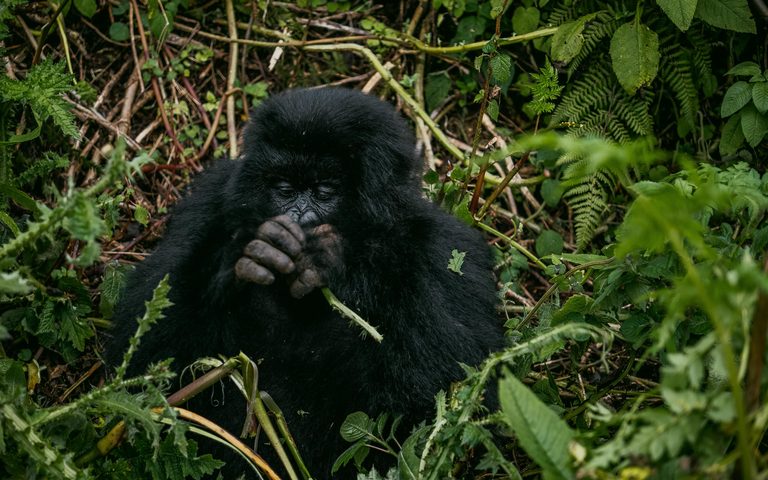
- Yes: some of the finest safaris in Africa happen in forest, not savannah. Mountain gorillas live only in the Virunga massif and Bwindi — nowhere else on earth.
- Rwanda's Volcanoes National Park and Uganda's Bwindi Impenetrable Forest are the two practical choices. Rwanda is the shorter journey; Uganda is the lower permit price.
- A trek is on foot at altitude, one hour with the family once you reach them, and anywhere from forty minutes to six hours of walking to get there.
- The permit is the constraint, not the lodge: numbers are capped daily and the minimum age is fifteen. Secure permits before flights.
- It pairs naturally with the savannah — most itineraries put the forest first, while the legs are fresh, then the Mara or the Serengeti.
Yes — and it is a different safari entirely
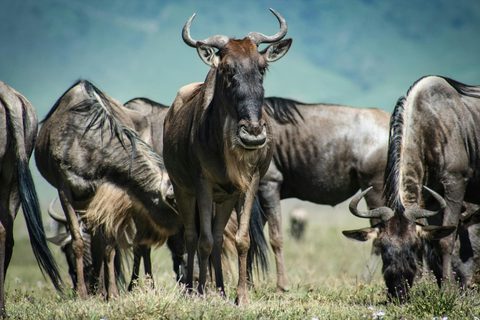
The word safari carries one picture: a private vehicle, an open plain, a guide reading tracks in the dust. That is East and Southern Africa's savannah, and it is most of what the industry sells. But some of the continent's most extraordinary wildlife lives in forest, and reaching it means walking rather than driving.
The distinction matters practically, not just poetically. A savannah safari is comfortable: you are seated, the animals come to the vehicle, and a guest of any age and fitness can do it. A forest safari asks something of you — altitude, mud, gradient, and an hour that ends whether you are ready or not.
Where the forest safaris are
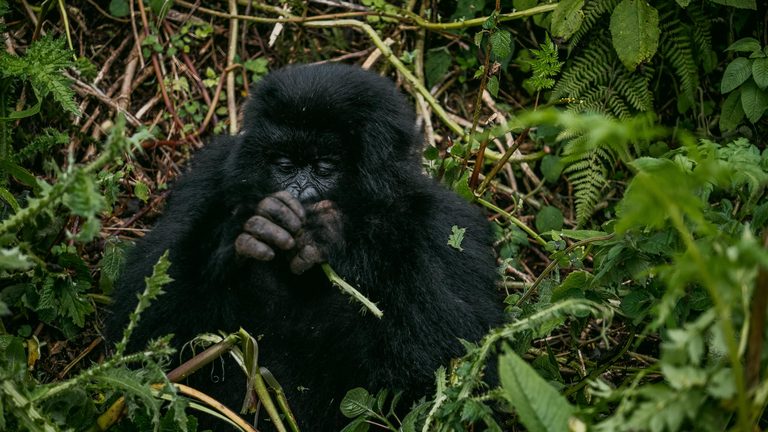
Mountain gorillas exist in two populations and nowhere else: the Virunga massif, shared by Rwanda, Uganda and the Democratic Republic of Congo, and Uganda's Bwindi Impenetrable Forest. In practice that means two choices. Rwanda's Volcanoes National Park, roughly two to three hours by road from Kigali, and Uganda's Bwindi, reached by light aircraft from Entebbe or a long and beautiful drive.
Chimpanzees are a separate journey again: Nyungwe Forest in southern Rwanda, and Kibale in Uganda, which is the denser and more reliable of the two for habituated groups.
What a gorilla trek actually is
You start early, are assigned a gorilla family, and walk. Trackers have been with the family since dawn and radio their position, so the walk is purposeful rather than a search — but it can be forty minutes or it can be six hours, at between 2,300 and 3,000 metres, on ground that is frequently vertical and usually wet. Porters carry your bag and, if the day asks for it, help pull you up.
When you reach them you have one hour. Eight visitors per family per day, no more. That hour is the whole product, and it is why the trek is priced the way it is.
Permits are the constraint, not the camps
A gorilla permit is a government-issued daily place, capped and dated. At the time of writing Rwanda's is US$1,500 per person per trek and Uganda's US$800, with Uganda's habituation experience — four hours rather than one, with a family still being accustomed to people — priced closer to Rwanda's. Both countries reprice them, so treat these as the shape of the number and confirm at booking.
Two consequences follow. Permits are secured before flights, not after. And the minimum age is fifteen in both countries, strictly enforced — which decides whether a family trip works at all, and is the single most common reason a plan has to be redrawn.
Where to stay, and why it is worth the difference
In Rwanda, Singita Kwitonda and One&Only Gorilla's Nest sit close to the park boundary, and Bisate Lodge is built into an eroded volcanic cone with a reforestation programme guests take part in. In Uganda, Bwindi Lodge and Sanctuary Gorilla Forest Camp put you inside or against the forest edge.
Proximity is not a luxury detail here. A lodge twenty minutes from the briefing point instead of ninety changes what a 5am start feels like, and on a one-hour-per-day product the margin matters.
See also: Safaris · Kenya vs Tanzania · Which Country Has the Best Luxury Safari?
How it pairs with the savannah
Most itineraries that include both put the forest first, while the legs are fresh, and finish on the plains — Rwanda's Akagera, Kenya's Mara conservancies or Tanzania's Serengeti — where the days are seated and slow. Ten to twelve nights carries both without either feeling rushed; under eight and one of them becomes a stopover.
The reverse order works for guests who want the harder day behind them, but it costs you the trek at your fittest.
Questions, answered.
Yes. Alongside the savannah safaris of Kenya, Tanzania and Botswana, some of Africa's finest wildlife is in forest: mountain gorillas in Rwanda's Volcanoes National Park and Uganda's Bwindi Impenetrable Forest, and chimpanzees in Nyungwe and Kibale. The difference is that a forest safari is on foot, at altitude, rather than from a vehicle.
Rwanda for the shorter journey — two to three hours by road from Kigali, and the finest lodges sit on the park boundary. Uganda for the lower permit price and a wilder, denser forest, at the cost of a light flight or a long drive from Entebbe. Guests with limited days generally choose Rwanda; guests who want more forest and more time choose Uganda.
At the time of writing, US$1,500 per person per trek in Rwanda and US$800 in Uganda, with Uganda's four-hour habituation experience priced closer to Rwanda's. Both governments reprice them, so confirm at booking. The permit is separate from the lodge and is secured first.
Fitter than a savannah safari asks, and less fit than people fear. The walk is between forty minutes and six hours at 2,300 to 3,000 metres, on steep and usually wet ground. Porters carry your bag and help on the climbs. Guests in their seventies do it; the limiting factor is usually altitude and knees rather than distance.
Not under fifteen. Both Rwanda and Uganda enforce a minimum age of fifteen, without exception, which is the most common reason a family itinerary has to be redrawn. Younger children can travel with the party and stay at the lodge, and a savannah safari has no such restriction.
It is the usual shape of the trip. The forest goes first, while the legs are fresh, then the plains — Akagera in Rwanda, or on to the Mara or the Serengeti. Ten to twelve nights carries both comfortably; under eight and one of them becomes a stopover.
On a gorilla trek in Rwanda's Volcanoes National Park or Uganda's Bwindi, you start early and are assigned a gorilla family. Trackers have been with that family since dawn and radio its position, so the walk has a clear destination. When you reach the gorillas you have one hour with them, and no more than eight visitors may see each family per day. That hour is the whole experience and the reason the trek is priced as it is.
Uganda's gorilla habituation experience gives you four hours with a gorilla family instead of the standard one, and the family is one still being accustomed to people. It is priced closer to Rwanda's US$1,500 permit than to Uganda's standard US$800 permit, at the time of writing. Both countries reprice their permits, so confirm the figure at booking. Like all gorilla permits, it is secured before flights.
For chimpanzees, Kibale in Uganda is the denser and more reliable of the two for habituated groups. Nyungwe Forest, in southern Rwanda, is the other option. Chimpanzees are a separate journey from the mountain gorillas, which are found only in the Virunga massif, shared by Rwanda, Uganda and the Democratic Republic of Congo, and in Uganda's Bwindi Impenetrable Forest.
Lodge proximity matters on a gorilla trek because the day starts around 5am and the encounter itself lasts one hour. A lodge twenty minutes from the briefing point instead of ninety changes how that early start feels. In Rwanda, Singita Kwitonda and One&Only Gorilla's Nest sit close to the Volcanoes National Park boundary; in Uganda, Bwindi Lodge and Sanctuary Gorilla Forest Camp sit inside or against the forest edge.
For savannah safaris, Kenya, Tanzania and Botswana; for forest safaris, Rwanda and Uganda, the two practical places to see mountain gorillas. Many itineraries pair both: the gorilla trek first, in Rwanda's Volcanoes National Park or Uganda's Bwindi, while the legs are fresh, then the plains of Akagera, Kenya's Mara conservancies or Tanzania's Serengeti. Ten to twelve nights carries both comfortably; your advisor matches the country to season, fitness and party.
Safaris
See the collection →Tell a private advisor how you like to travel — no quotes, no obligation.
Speak With a Luxury Travel AdvisorA real person answers: an in-house luxury travel advisor, in English or Spanish. The first conversation is complimentary.